
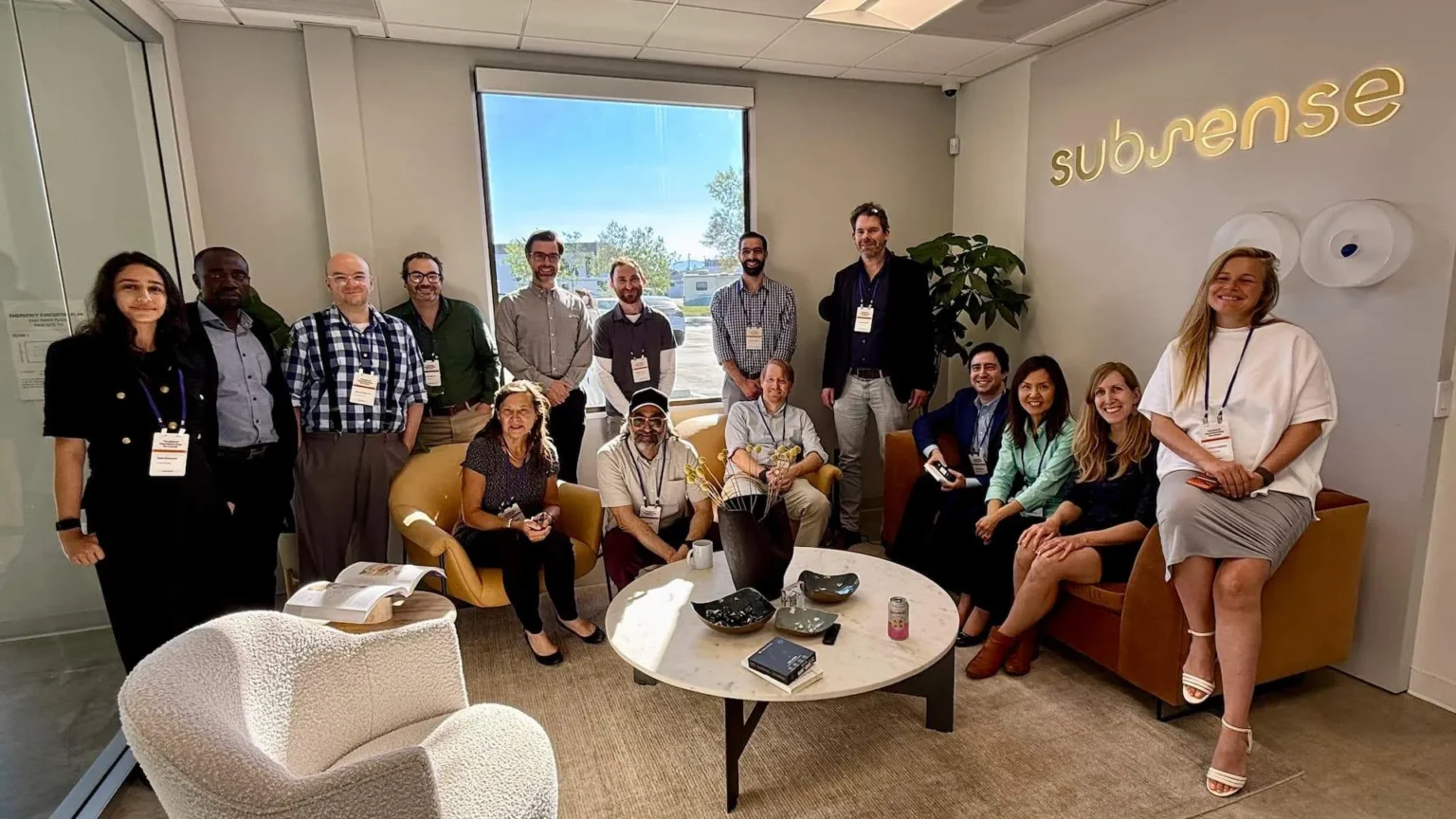
Subsense’s Inaugural Roundtable
Translational Neurotechnology Roundtable: Reimagining the Neural Interface
Bringing together leaders across nanotechnology, neuroscience, clinical medicine, and AI to examine what it will take to move neural interfaces from concept to real-world clinical impact
In March, the Subsense team convened its first roundtable with a select group of guests for a focused, working discussion on the future of neural interfaces. The session brought together experts across disciplines to unpack the core technical, biological, and clinical challenges that must be solved to translate emerging brain-computer approaches into practical systems.
The discussion featured world-leading experts that reflected the interdisciplinary nature required to push the field forward:
- Naomi J. Halas, Ph.D., Rice University: A pioneer in plasmonics and nanophotonics, focused on applying nanoscale materials to biomedical and sensing applications.
- Jennifer Dionne, Ph.D., Stanford University: A leader in nanophotonics developing tools to observe and control biological processes at the nanoscale.
- Andrew Jackson, Ph.D., Newcastle University: An expert in neural interfaces and brain-machine systems, focused on restoring and modulating human function.
- Corey Keller, M.D., Ph.D., Stanford University: A physician-scientist specializing in neurostimulation and mapping brain circuits for therapeutic use.
- John-Clark Levin, Kurzweil Technologies: An AI and systems advisor focused on scaling emerging technologies and their long-term impact.
The two-day roundtable focused on what’s actually holding neural interfaces back from real-world use. The sessions covered points across biology, hardware, and data, the role of materials in enabling stable interaction, and what it takes to translate signals into outcomes that matter. Broader considerations around scalability, system design, and responsible deployment also shaped the conversation.
The key takeaway: progress in BCI won’t come from incremental steps alone. It will require tighter coordination across disciplines and a more grounded understanding of real constraints. We look forward to continuing these discussions in future roundtables, with a sharper focus on turning scientific progress into meaningful applications.